This article is triggered by a recent post about AI by Gary Marcus, an American psychologist and cognitive scientist, who comments frequently on the limitations inherent in Generative AI systems. In his post he said:
Nobody (from the AI companies) ever wanted to talk science.
Yet it is science, and the mathematics that underpins it, that is the foundation for so much progress in the modern world. Science is also itself underpinned by instrumentation and techniques that have been developed for looking within the unknown.
It was the techniques developed for the creation of X-ray diffraction images that provided the key insights which enabled James Watson, an American biologist, and Francis Crick, an English physicist, to determine, in 1953, that the geometric structure of DNA was the double helix. The image in ‘Photograph
51’, taken by Rosalind Franklin, enabled several key insights:
i) That DNA is a helix (from the X pattern)
ii) The fundamental repeats are 3.4 Angstrom apart
iii) The pitch of the helix is 34 Angstrom
iv) There is more than one strand (The Double Helix)
So insightful instrumentation can be very, very useful.
Unfortunately, mainstream AI research clearly lacks such super useful instrumentation, a truth that can easily be deduced from the failure of the Generative AI suppliers to report improvements in Anaphoric Reference Resolution Accuracy (ARRA), and yet ARRA must be, as a minimum, very close to 100% for an AI system to have any hope of approaching AGI.
Without any measurements reporting fundamental progress, claims of improvements are merely arm waving, often supported by benchmark tests that fit the capabilities of the test system. This is in contrast to what would be a scientific analysis of the key issues.
I use a research focused AI Voice Assistant called HodgePodge Data (HPD) for my own research into language, memory and human-quality conversations and this runs in an environment called Studio.
Studio provides a precise window into the analysis of conversations and it also provides a window into the memories created. This in turn enables the essential context memories, required for human-quality conversations, to be verified.
Although I usually write about HodgePodge Data, it has been the analysis provided by Studio that has provided access to the fundamental geometric structures that must, of necessity, underpin human-quality conversations.
Crick and Watson made several attempts to determine the geometry of DNA. As they acquired more data and gained increasing insights into the key issues they finally succeeded in 1953. They could then explain the double helix structure of DNA, with a geometry that allowed all constituent parts of the double helix to fit together.
The focus of my own research is into the geometry that must underpin the structure of human memory, a geometry that must explain how human quality conversations can be so effortless. I started my research in 2006, and it was to take me 10 years to discover The Fundamental Theorem Of Cognition (TFTOC).
Just as the double helix has provided the key insight into human biology TFTOC has provided a similar key insight into how human memories must be formed and accessed i.e. TFTOC provides the essential gateway for human-quality AI conversations and leads to a geometry that provides accurate conversations free of hallucinations.
Edwin Land, an American scientist and engineer, best known as the co-founder of the Polaroid Corporation, demonstrated in the late 1950s that human perception of colour and intensity was a field
and not a point phenomena.
It is simple to show that a similar observation can be made about language, where the meaning of an utterance is determined by the context in which it occurs, i.e. the field. Context is the field of the existing cognitive memories, structured in a precise geometrical pattern so as to create discoverable memories that can easily resolve meaning. However, before context can work its magic there must be a first step. This requires all of the anaphoric references used in an utterance to be accurately resolved. I used the term anaphoric here in its widest sense, pronouns such as I, you, he, she, it etc. but also all of the indirect cognitive references that can only be determined from the history of the evolving conversation – e.g. Location (‘there’) and Time (‘that morning’) are simple examples.
Studio is an intelligent instrument that can verify the analysis of sentences and also verify that all anaphoric references have been correctly resolved. It also provides a window into the context memories that have been created as a conversation evolves. This is science!
In contrast: Today (19 August 2025) I have attempted a very simple conversation with ChatGPT which included the very simple anaphoric reference ‘his’, used in the phrase ‘his older sister is 12’.
Now in the previous turn, both in the input and in the response, there was only a reference to one male person ‘Ben’, and therefore human-quality anaphoric reference resolution would accurately resolve the ‘his’ reference to ‘Ben’.
No doubt, if ChatGPT incorporated science into its algorithms, then it would have also accurately resolved the ‘his’ reference – but it doesn’t and it didn’t. Instead, in a complete breach with human cognitive processes, the ‘his’ is resolved to another male person last mentioned three turns previously!
Anyone who believes that AGI is achievable without accurate resolution of anaphoric references is either living in a parallel universe or does not understand even the basic science that underpins the human use of language – of which anaphoric references are a critical component.
As for Generative AI systems achieving super-intelligence, this, as with many areas of bad science, will surely require a redefinition of the meaning of the term.
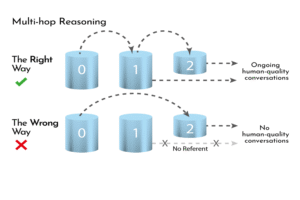
Postscript: Let me provide some further clarity on the issue of human-quality AI capabilities, given that there are now an increasing number of proposals for enhancing the reasoning capabilities of a Generative AI system. These proposals may lead one to wrongly believe that reasoning is an almost solved problem. However, we must remember that key insight: Garbage In = Garbage Out.
Given the prevalence of anaphoric references in human language, the inability of Generative AI systems to reliably resolve them means that such systems will be frequently reasoning with confused data. This is not a future that inspires confidence for applications of a critical nature such as finance, health and other life critical areas.
I hope this final point makes clear the importance of ARRA, and it highlights the lack of precise measurements of basic capabilities of Generative AI systems.
Where indeed is the science?
Finally, for any organisation that is looking, or should be looking, i.e. Amazon, Apple, Meta and Samsung, for proven mathematics for human-quality AI Assistants – which must of necessity include highly accurate anaphor reference resolution, the key algorithms can be licensed from Precise Intelligence Ltd.
With the instrumentation provided by Studio and the geometry derived from The Fundamental Theorem Of Cognition (TFTOC), the new mathematics can provide accurate anaphor resolution – an absolutely essential component for human-quality AI Voice Assistants.